 Columbus OVI/DUI Attorney Blog


 As a community, we want to protect children. For that reason, some criminal laws in Ohio have increased penalties when the prohibited conduct affects juveniles. One such proposed law is currently before the Ohio General Assembly. If passed, the bill would enhance some vehicular offenses which occur in an active school zone and raise penalties for other traffic offenses which occur in a school-adjacent sector.
Aspen Runnel’s Law
The proposed legislation is House Bill 203, known as Aspen Runnels’ Law. The Bill was prompted by two crashes involving students walking to and from school in Ohio’s Lakota Local School District. One of those students, Aspen Runnels, died after being struck by a vehicle in a crosswalk in 2024. In response, Ohio Representatives Thomas Hall and Josh Williams introduced House Bill 203.
 The Ohio laws prohibiting Vehicular Homicide and Vehicular Assault only apply if certain vehicles are used in the commission of the offense. For example, someone who causes the death of another person while riding a bicycle under the influence cannot be convicted of Aggravated Vehicular Homicide because ‘bicycle’ is not a vehicle listed in the statutes. The list of applicable vehicles has changed over the last couple years and will soon change again.
 I was recently interviewed by Steve Sleeper for his
 A driver struck a trooper while the trooper was directing traffic, and the trooper suffered serious injuries. The driver submitted a urine sample, and a urine test showed a concentration of inactive marijuana metabolite above the ‘legal limit’. The driver was charged with and convicted of Aggravated Vehicular Homicide and DUI (called ‘OVI’ in Ohio). The Ohio Supreme Court
 An Ohio man pled guilty to Aggravated Vehicular Homicide and other charges. A few days before the sentencing was to be held, the defendant hired a new lawyer and filed a motion to withdraw his guilty plea. The judge held a hearing and
 The defendant in an Ohio Vehicular Homicide/Vehicular Assault case filed a motion to suppress the results of his blood test. Blood test results may be suppressed for various reasons. In this case, the defendant argues the blood test did not comply with the requirements of the Ohio Revised Code and the Ohio Administrative Code.
 A recent appellate case involves two legal issues which are often litigated in Vehicular Homicide and Vehicular Assault cases in Ohio. The first issue is the admissibility of expert witness testimony. The second issue is whether the jury should be instructed about the option of finding the defendant guilty of a lesser offense. The case is
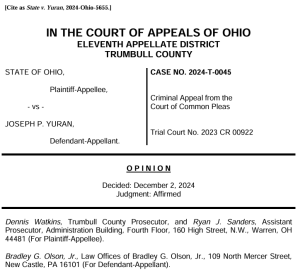 A former Pennsylvania state trooper was involved in a two-vehicle automobile crash, and the driver of the other vehicle died as a result. The former trooper, Joseph Yuran, was charged with Aggravated Vehicular Homicide as a second-degree felony and Operating a Vehicle under the Influence (OVI). Yuran pled guilty to those charges, and the judge imposed a prison term of 7 years to 10.5 years. Yuran appealed the sentence to the 11th District Court of Appeals, claiming the sentence was unlawful.

 According to