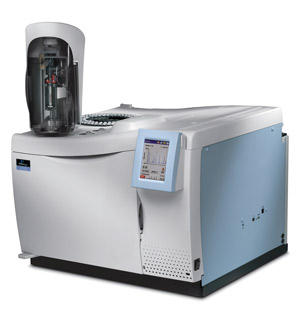
Somewhere between ten percent and twenty percent of Americans have GERD: Gastro Esophageal Reflux Disease. While the advertisements by pharmaceutical companies have made GERD common knowledge, it is no so commonly known that this medical condition can inflate the result of an alcohol breath test. When the defendant in an OVI case has GERD, lawyers and judges find themselves at the intersection of law and science.

Articles Posted in DUI/OVI blood/breath/urine tests
Unanimous Supreme Court Reinforces Defendant’s Right To Challenge Breath Test Results In Ohio DUI/OVI Cases
For three decades, lawyers and judges have been misinterpreting the case of State v. Vega. In Vega, the Ohio Supreme Court held defendants in DUI/OVI cases may not attack the general reliability of breath-testing machines. Some lawyers and judges interpret Vega as if it says defendants are not permitted to make any challenge to the breath test result. This misinterpretation of the Vega decision may exist in part because most people have not actually read the decision. It’s like the telephone game where the statement made by the first person in the game is modified drastically by the time the statement is repeated by the last person in the game. A few days ago, the Ohio Supreme Court clarified the holding of Vega in a case which will hopefully end the abuse of defendants’ rights resulting from the misinterpretation of Vega.
New Book Provides Readers With Valuable Information About DUI/OVI In Ohio
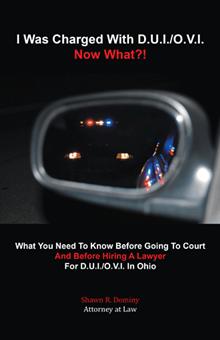
It won’t win a Pulitzer Prize, it will not be mentioned with the New York Times best sellers, and it will not be at the top of readers’ ‘wish lists’. In fact, most people may not find it very interesting. If you are charged with a DUI/OVI in Ohio, however, this book suddenly becomes a must-read. I’m talking about the new book: I Was Charged With DUI/OVI, Now What?!
Driver’s License Suspended For Inability To Urinate On Cue
Imagine that you are arrested for DUI (called OVI in Ohio), and the officer takes you to a police station to take a urine test. You want to comply, because you’re sure the test will prove you are under the legal limit, but you don’t need to go. In fact, you can’t go. You drink a bunch of water and wait a while, but you still can’t go. The officer then says you refused the urine test, so your driver’s license is suspended for one year.
Margin Of Error In Ohio DUI/OVI Alcohol Tests

From your bathroom scale to a police officer’s laser gun, every measurement device has a margin of error. For a device to be considered reliable, the margin of error must be known (and should be small!). In a recent Ohio DUI / OVI case, the court decided the admissibility of test results from a device with an unknown margin of error.
State v. Lancaster May Change Interpretation Of Ohio Breath Testing Law
Intoxilyzer 8000 Declared Unreliable In Ohio DUI/OVI Case
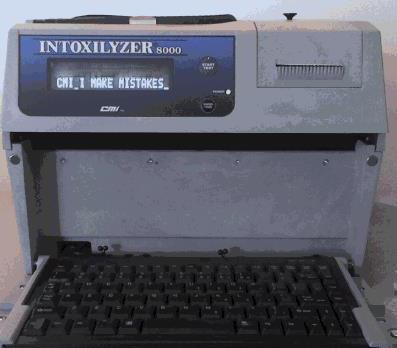
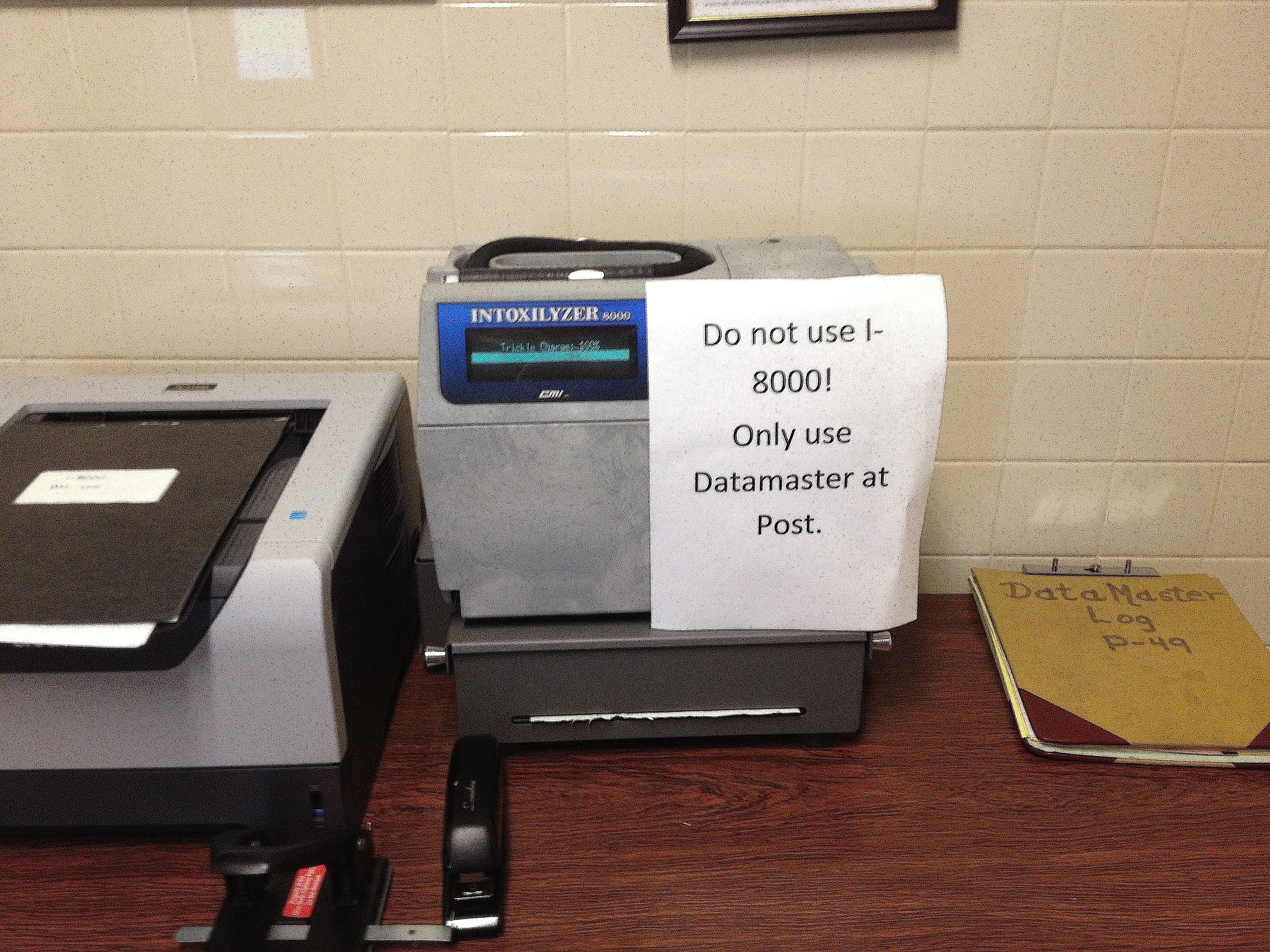
This blog has discussed Intoxilyzer 8000 litigation in many previous posts. One of those posts (November 18, 2012) mentioned the case of State v. Lancaster in the Marietta Municipal Court. I was asked to help with that litigation as counsel for Lancaster. Like many of the I-8000 cases throughout Ohio, the Lancaster case involves the reliability of the I-8000. Unlike most of the other cases, however, the Lancaster case includes testimony of expert witnesses for the prosecution and defense. After five days of testimony, the verdict is in, and the breath test is out! The decision has already been appealed and is staged to possibly change the interpretation of breath-testing law in Ohio.
Court Rescues Intoxilyzer 800 For Use In Ohio DUI/OVI Cases

But for a technical legal issue that may only be interesting to an Ohio DUI/OVI lawyer, the case of State v. McMahon would be pretty generic. An officer pulled him over for speeding, noticed the odor of alcohol, administered field sobriety tests, arrested him, gave him a breath test on an Intoxilyzer 8000, and charged him with O.V.I. McMahon filed a motion to suppress the results of the breath test, claiming the Department of Health was required to make rules for obtaining ‘operator access cards’ (to operate the I-8000) and never did. The trial court agreed with McMahon and threw out the breath test.
U.S. Supreme Court Decision Raises Questions About Blood Tests in Ohio D.U.I./O.V.I. Cases

In a previous post, this blog questioned whether police should be able to draw blood against your will without a search warrant. At that time, oral arguments had recently been held in the case of Missouri v. McNeely. A few days ago, the United States Supreme Court issued a decision in the McNeely case. Based on that decision, the Constitutionality of the law for forced blood tests in Ohio O.V.I. cases is questionable.
Appellate Court Rules On Intoxilyzer 8000 Admissibility In Central Ohio OVI Cases
For the first time, an appellate court in Central Ohio addressed whether evidence from an Intoxilyzer 8000 is admissible in an O.V.I./D.U.I. trial. The court of appeals ultimately decided that the defendant is prohibited from challenging the general reliability of the Intoxilyzer 8000, so the results of that machine’s breath tests are admissible. The court’s opinion, however, contained language questioning whether that prohibition should continue to be the law in Ohio O.V.I. cases.
Should Ohio Police Be Able to Draw Blood Against Your Will?

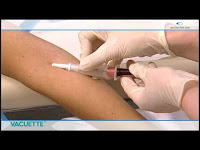
Trooper Mark Winder stopped Tyler McNeely for speeding and observed the usual trilogy of intoxication signs: odor of alcohol, bloodshot eyes, and slurred speech. Winder gave McNeely field sobriety tests and arrested him for driving while intoxicated. The trooper drove McNeely to a hospital and asked McNeely to give a blood sample. McNeely declined. Without obtaining or even seeking a warrant, the trooper had a lab technician take a blood sample from McNeely while McNeely was restrained. The blood sample was later analyzed, and it was determined that the concentration of alcohol in the blood was .154.
Columbus OVI/DUI Attorney Blog