 Columbus OVI/DUI Attorney Blog


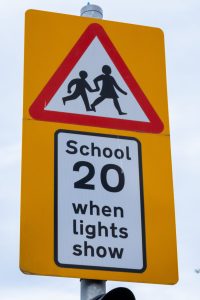 As a community, we want to protect children. For that reason, some criminal laws in Ohio have increased penalties when the prohibited conduct affects juveniles. One such proposed law is currently before the Ohio General Assembly. If passed, the bill would enhance some vehicular offenses which occur in an active school zone and raise penalties for other traffic offenses which occur in a school-adjacent sector.
Aspen Runnel’s Law
The proposed legislation is House Bill 203, known as Aspen Runnels’ Law. The Bill was prompted by two crashes involving students walking to and from school in Ohio’s Lakota Local School District. One of those students, Aspen Runnels, died after being struck by a vehicle in a crosswalk in 2024. In response, Ohio Representatives Thomas Hall and Josh Williams introduced House Bill 203.
The Bill is intended to strengthen protections for children traveling to and from school by elevating the consequences for certain traffic offenses occurring in active school zones and school-adjacent sectors. If enacted, the legislation would make important changes to Ohio’s Vehicular Manslaughter and Vehicular Assault laws, as well as other traffic violations.
Vehicular Manslaughter
According to Ohio Revised Code section 2903.06(A)(4), Vehicular Manslaughter is committed when a driver causes the death of another person as a proximate result of committing a minor misdemeanor traffic violation. Currently, Vehicular Manslaughter is typically a second-degree misdemeanor. A conviction carries a potential jail term of up to 90 days, a fine of up to $750, and a mandatory driver’s license suspension for three months to two years.
House Bill 203 would establish a more serious form of Vehicular Manslaughter when the offense is committed within an active school zone. A ‘school zone’ generally means that portion of a street or highway passing a school fronting upon the street or highway that is encompassed by projecting the school property lines to the fronting street or highway. The speed limit in a school zone is 20 m.p.h. during the times the school zone is active. A school zone is ‘active’ when speed limit signs are erected and children are arriving or leaving school during opening or closing hours. A school zone is also ‘active’ when children are at recess.
The proposed school zone offense would be classified as a fourth-degree felony. A driver convicted of the proposed offense would face a felony conviction, a prison term of six months to 18 months, a fine of up to $5,000, and a mandatory driver’s license suspension of two to ten years. The felony level and sentence are enhanced if certain circumstances exist. The convicted driver would also be required to complete a remedial driving course before reinstatement of the person’s driver’s license.
Vehicular Assault
According to Ohio Revised Code section 2903.08(A)(3), the misdemeanor version of Vehicular Assault is committed when a driver causes serious physical harm to another person as a proximate result of committing a speeding offense in a construction zone. This version of Vehicular Manslaughter is typically a first-degree misdemeanor. A conviction carries a jail term of seven days to 180 days, a fine of up to $1,000, and a mandatory driver’s license suspension for one year to five years.
House Bill 203 would expand the statute to address situations in which a driver causes serious physical harm as the proximate result of speeding or committing a minor misdemeanor traffic violation in an active school zone. The new school-zone offense would be classified as a fifth-degree felony. A driver convicted of this offense would face a felony conviction, a prison term of up to 12 months, a fine of up to $2,500, and a mandatory driver’s license suspension of one to five years. Under certain circumstances, the felony level and sentence are enhanced. The legislation would also require a remedial driving course before driver’s license reinstatement.
Increased Fines For Other Traffic Offenses
House Bill 203 would also authorize courts to impose doubled fines for specified traffic violations committed in a school-adjacent sector. A ‘school-adjacent’ sector is the portion of a street or highway within an active school zone to which either of the following applies: (1) the portion includes a crosswalk abutting school property that is used by pedestrians to access the school property; or (2) the portion is surrounded by school property on both sides of the street or highway. There are 28 traffic violations to which the doubled-fine provision would apply.
The Progress of House Bill 203
The Bill was passed by the House of Representatives on March 25, 2026. The following day, it was introduced in the Ohio Senate. It is currently the subject of hearings in the enate Judiciary Committee. Consequently, the enhanced penalties discussed in this article remain proposed changes rather than enacted law. For now, the proposal illustrates how Ohio’s Vehicular Homicide and Vehicular Assault laws continue to evolve in response to concerns about traffic safety and the protection of children.