 Columbus OVI/DUI Attorney Blog


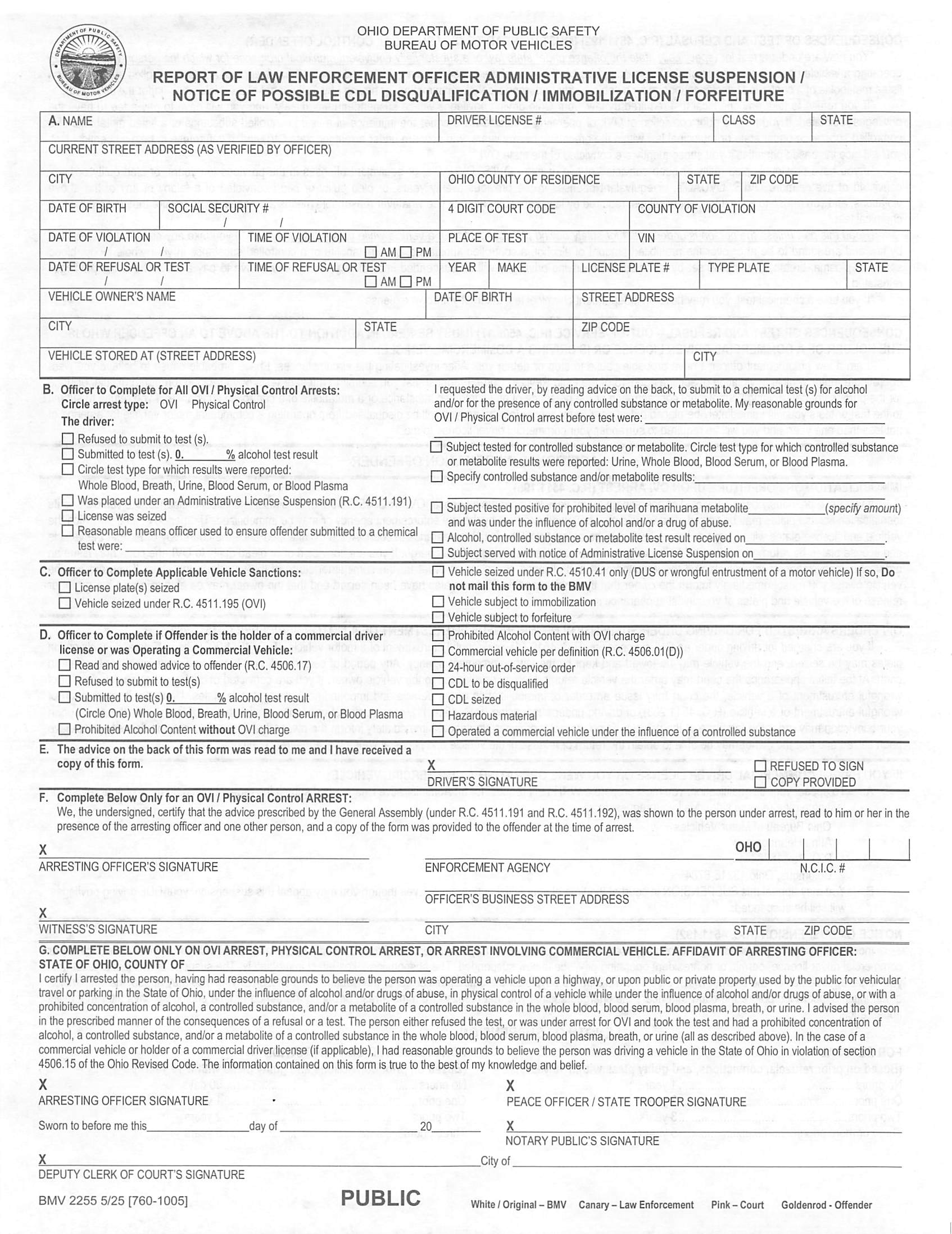 If you are arrested for DUI (called ‘OVI’ in Ohio), you can lose your driver’s license immediately, before even going to court or seeing a judge. That loss of driving privileges, imposed by the BMV (not a court), is an Administrative License Suspension (ALS).
The ALS is triggered by a single document completed by the arresting officer: the BMV Form 2255. That form was revised in 2025. The revisions are important in the context of Ohio’s implied consent law and can affect the validity of an ALS.
Implied Consent in Ohio
Ohio’s implied consent law is outlined in Ohio revised Code section 4511.191. In simple terms, the law says, if you operate a vehicle (or are in physical control of a vehicle) in Ohio, you have already agreed to chemical testing if you are arrested for OVI. Chemical testing is used to measure alcohol and drugs in a person’s breath, blood, urine, and oral fluid.
If a driver refuses a chemical test, or tests above the ‘legal limit’, an ALS is imposed. The suspension starts immediately, does not depend on a conviction, and can remain in place even if the OVI charge is later dismissed.
Officers’ Duties When Imposing an ALS
According to Ohio Revised Code section 4511.192, the arresting officer must follow a series of steps before imposing an ALS. The officer is required to explain the consequences of refusing or taking a chemical test, read the required warnings, request a chemical test within the required time frame, and complete a sworn report.
What is the BMV Form 2255?
The sworn report discussed in ORC 4511.192 is the BMV Form 2255. The form documents why the officer believed there were grounds for the OVI arrest. It shows whether the driver refused a chemical test or what the test result was. It also serves as notice to the driver that an ALS has been imposed and gives the BMV the information it needs to place the suspension on the drivers record.
The BMV Form 2255 is also used as evidence in ALS appeals. If the form is not read, completed, sworn, and served in the way the law requires, the form may not serve as evidence in the appeal.
Why the BMV Form 2255 is Important
Ohio law directly ties to the legality of an ALS to the sworn report completed by the arresting officer, and that sworn report is the BMV 2255. Under ORC 4511.192, the officer must send the report to the BMV within 48-hours, confirm that the required warnings were read and shown to the driver, document whether the driver refused testing or tested above the ‘legal limit’, and confirm the driver was provided a copy of the form. Because the ALS takes away a person’s driver’s license without any court involvement, Ohio law requires officers to follow the statute very closely.
The statute also states that the sworn report is prima facie proof of the suspension. In other words, the BMV and the court rely on the BMV Form 2255 itself as the evidence supporting the ALS. That is why mistakes on the form matter. When those requirements are not followed, the suspension may be legally invalid.
What changed in the 2025 version of the BMV Form 2255?
In 2025, the BMV updated Form 2255 to reflect recent changes to Ohio’s OVI and implied consent laws. The updated form clearly documents a copy of the form was provided to the driver at the time of arrest. It also contains revised language related to controlled substances and metabolites to match current OVI law. In addition, it includes a section addressing forced chemical testing in certain repeat-offender situations. In addition, the affidavit and certification sections were revised to reflect the current statutory requirements.
These changes are not just formatting updates. They are tied directly to changes in the law and place specific obligations on arresting officers. A form which was sufficient under prior law may no longer meet the statutory requirements after the 2025 update to ORC 4511.192.
Why the BMV Form 2255 Matters
An ALS is only valid if it is imposed exactly the way Ohio law prescribes. Due process normally requires a hearing before taking property, and a driver’s license is property. Courts permit an immediate license suspension, without a prior hearing, because the statute includes specific procedural protections for drivers.
When those protections are missing, the ALS may be invalid. Some officers continue to use older versions of the BMV Form 2255. When that happens, the current requirements for imposing an ALS may not be fulfilled, and the ALS may be terminated.
Conclusion
The BMV Form 2255 is more than routine paperwork: it is the foundation of every ALS imposed in Ohio OVI cases. With the 2025 revisions to the form, careful review is more important than ever. When the wrong version is used and the statutory requirements are not followed, the suspension may not hold up. For a person subjected to an ALS, it would be wise to consult an OVI defense lawyer who is knowledgeable about Ohio’s implied consent laws.